
Saturday, August 27, 2011
Free shipping special!
Receive free shipping within the U.S.A. at our etsy shop until Labor Day by using the coupon code "laborday2011". Hurry to get first picks on out new inventory of unique boards!


Friday, August 19, 2011
Selected work of the week: Dovetail joinery of epic proportions.
Recently we had the opportunity to work on a one of a kind custom bench. The bench was made from wormy chestnut that dates back 200+ years. The wormy chestnut was salvaged from a stock/tobacco barn in Madison county N.C. built just before the civil war. The building was constructed using these beams and old fashioned dovetail joinery. We thought that using this same joinery technique to construct this bench would not only be the strongest and cleanest looking design, but it would respect the craftsman who originally hand hewn the logs and hand cut the dovetail joints for the building. Dovetailed corners on an building never needed to be fastened in any way due to the the angle of the dovetail and gravity constantly pulling down on the beams which naturally pulls the corner tight. We maintained that same level of craftsmanship on our bench.
May these 200+ year old wormy chestnut beams live another 200+ years in the form of a bench!
Enjoy the pictures!


Tuesday, August 16, 2011
The Facebook fan cutting board giveaway!
Ok, here is how to play. Seach our Appalachian Joinery Etsy shop for a cutting board with the word "facebook" listed as one of the "tags". Once you have found that board, post the listing # of that board on our Chester Shuey Handcrafted Facebook page and you win. The board will be mailed to you with free shipping in 3-4 days. Good luck everyone!
Here's or etsy shop url: http://www.etsy.com/shop/AppalachianJoinery?ref=pr_shop_more

Sunday, August 14, 2011
New salvaged Appalachian serving and cutting boards!
The new inventory includes three beautiful Appalachian hardwood species. First, a few gorgeous honey locust boards made from a storm felled tree from a mountain top property north of Asheville, NC. Honey locust is a very hard, very stable wood and was traditionally used for outdoor structures because it is highly rot resistant and naturally stands up to water. Second, beautiful box elder boards we made from a tree that was felled by a tree service on a residential property in Barnardsville, NC. Box elder is used primarily for accent furniture due to its mesmerizing figure and unique red-streaked grain. Last but not least, our classic Appalachian black walnut boards are back! The black walnut tree was felled by a local tree service here in Asheville, NC and stored in a cabinet shop for 10 years. Black walnut is prized for furniture making due to its beautiful chocolate and nut brown color. All of the wood we use for our boards is air dried for at least one year and then kiln dried for two weeks to eliminate warping and unwanted moisture. I hope these trees will have a great second life!
Enjoy the pictures and to see more of these boards look for them very soon this week on our Etsy shop.


Wednesday, June 22, 2011
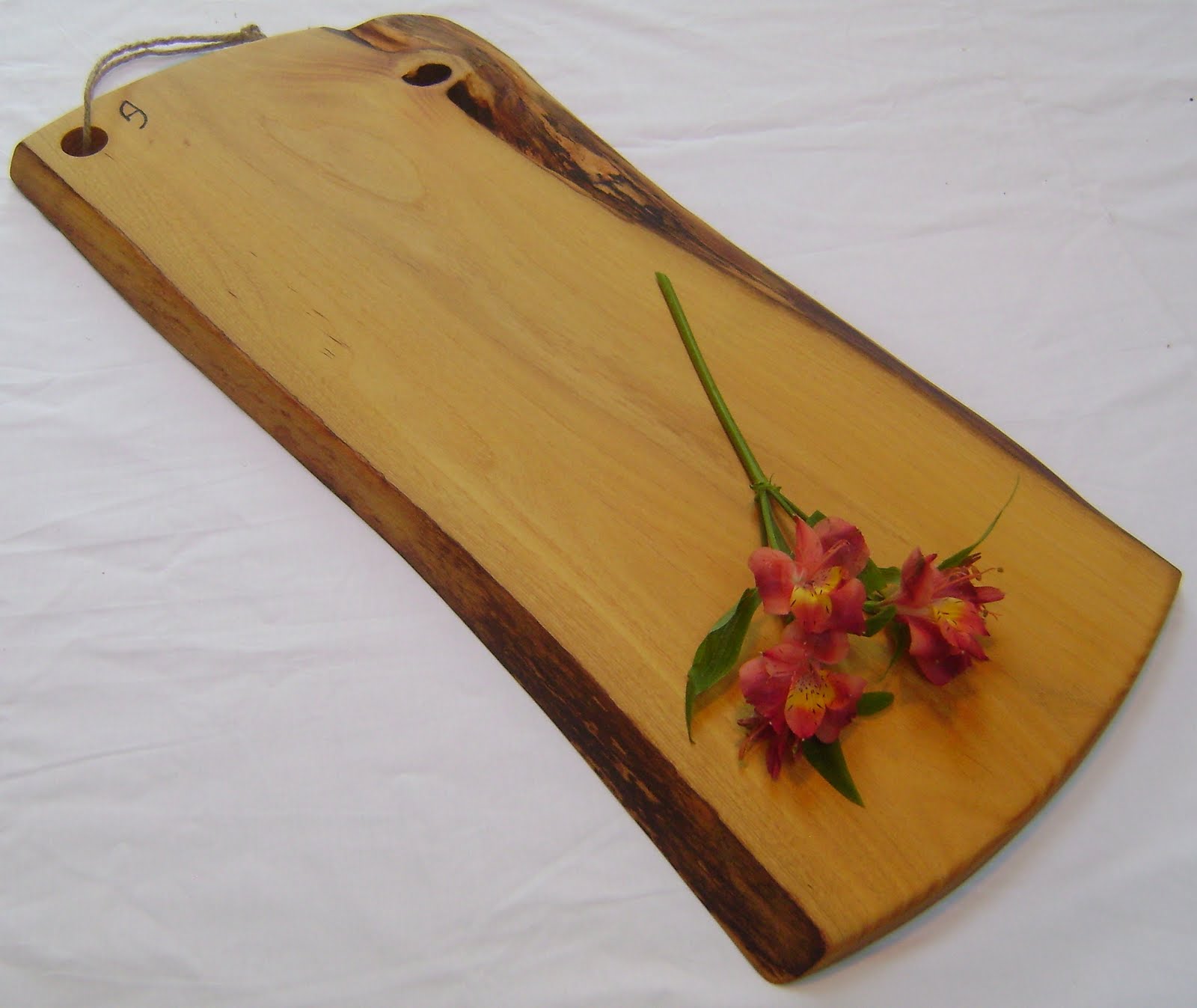
The very last of our gorgeous salvaged english walnut supply is on etsy.
About 2 years ago we are able to salvage a huge english walnut tree that was damaged in a storm. Ever since then we have been making custom furniture from the main log, cutting/serving boards from the limbs, and anything too small to work with was put in the shop wood stove for to keep us warm in the winter. It was truly a please to work with this beautiful and hard wood. We were glad repurposed this tree into functional and beautiful objects that have been shipped all over the world to people that share a passion for earth conscious handmade items.
Here are some of the great things our customers have said -
http://www.etsy.com/people/AppalachianJoinery/feedback?ref=pr_feedback
Here are a few pictures of the very last of this tree-


You can see more boards here-
http://www.etsy.com/shop/AppalachianJoinery?ref=pr_shop_more
Here are some of the great things our customers have said -
http://www.etsy.com/people/AppalachianJoinery/feedback?ref=pr_feedback
Here are a few pictures of the very last of this tree-


You can see more boards here-
http://www.etsy.com/shop/AppalachianJoinery?ref=pr_shop_more
Saturday, June 18, 2011
New boards!!
Flamed red birch from the Biltmore estate grounds and gorgeous figured wild black cherry!


Monday, May 23, 2011
Salvaged Appalachian red birch off the Biltmore estate.
This is one of our greatest finds yet to date! We have a few pieces of a huge red birch tree that fell down during a storm on the Biltmore estate. The tree was quickly cared for and we were able to purchase a few pieces from our sawyer. Red birch slightly resembles black cherry when milled and finished.
Here are a few pictures and the history of the Biltmore estate.


Building Biltmore was, at the time, one of the largest undertakings in the history of American residential architecture and the results were astounding. Over a six-year period, an entire community of craftsmen worked to build the country's premier home. The estate boasted its own brick factory, woodworking shop, and a three-mile railway spur for transporting materials to the site.
A New World Château
The celebrated architect Richard Morris Hunt modeled the house on three châteaux built in 16th-century France. It would feature 4 acres of floor space, 250 rooms, 34 bedrooms, 43 bathrooms, and 65 fireplaces. The basement alone would house a swimming pool, gymnasium and changing rooms, bowling alley, servants' quarters, kitchens, and more.
An Environmental Wonder
The grounds of the 125,000-acre estate were designed by Frederick Law Olmsted, the creator of New York's Central Park and the father of American landscape architecture. He not only developed acres of gardens and parkland, but in his efforts to protect the environment and reclaim over-farmed land, Olmsted established America's first managed forest.
A True Family Home
George Vanderbilt officially opened the home to friends and family on Christmas Eve in 1895. He had created a country retreat where he could pursue his passion for art, literature, and horticulture. After marrying the American Edith Stuyvesant Dresser (1873–1958) in Paris during the summer of 1898, George and his new bride came to live at the estate. Their only child, Cornelia (1900–1976), was born and grew up at Biltmore.
Here are a few pictures and the history of the Biltmore estate.


Building Biltmore was, at the time, one of the largest undertakings in the history of American residential architecture and the results were astounding. Over a six-year period, an entire community of craftsmen worked to build the country's premier home. The estate boasted its own brick factory, woodworking shop, and a three-mile railway spur for transporting materials to the site.
A New World Château
The celebrated architect Richard Morris Hunt modeled the house on three châteaux built in 16th-century France. It would feature 4 acres of floor space, 250 rooms, 34 bedrooms, 43 bathrooms, and 65 fireplaces. The basement alone would house a swimming pool, gymnasium and changing rooms, bowling alley, servants' quarters, kitchens, and more.
An Environmental Wonder
The grounds of the 125,000-acre estate were designed by Frederick Law Olmsted, the creator of New York's Central Park and the father of American landscape architecture. He not only developed acres of gardens and parkland, but in his efforts to protect the environment and reclaim over-farmed land, Olmsted established America's first managed forest.
A True Family Home
George Vanderbilt officially opened the home to friends and family on Christmas Eve in 1895. He had created a country retreat where he could pursue his passion for art, literature, and horticulture. After marrying the American Edith Stuyvesant Dresser (1873–1958) in Paris during the summer of 1898, George and his new bride came to live at the estate. Their only child, Cornelia (1900–1976), was born and grew up at Biltmore.
Tuesday, May 17, 2011
Selected work of the week: French country vanity.
This week we chose to highlight a custom french country style vanity with hand turned hard maple legs, and mortise and tenon joinery. We love pieces like these because we get to be creative and explore classic designs while fulfilling our customers needs.
Enjoy the pictures.


Enjoy the pictures.


Sunday, May 15, 2011
New boards! Salvaged Appalachian crab apple.
The wood in these boards came from a tree located in northern Asheville NC. It was once a fruit bearing tree and provided for its owners for years. It was damaged in a storm about 6 months ago and our local sawyer was quick in saving and caring for the material so it may be used for woodworking. We decided with all of the character the wood had to offer serving and cutting boards would best suit the material.
We would also like to mention the wonderful chef's knife in the pictures below was custom crafted for us from 100% reused materials by C. Thomas. You can find there shop "theknife" on www.etsy.com as well.
Enjoy the pictures below and If you see on you like you can find it on our Appalachian Joinery shop page at www.etsy.com


We would also like to mention the wonderful chef's knife in the pictures below was custom crafted for us from 100% reused materials by C. Thomas. You can find there shop "theknife" on www.etsy.com as well.
Enjoy the pictures below and If you see on you like you can find it on our Appalachian Joinery shop page at www.etsy.com


Wednesday, May 11, 2011
Salvaged Mammoth Kauri carbon dated to be 30,000-50,000 years old.
With our work we use mostly locally salvaged Appalachian hardwood to build our furniture, however we have recently found rare access to a very limited supply of Salvaged Ancient Mammoth Kauri originating in New Zealand. The Kauri has been cut into huge slabs measuring about 4' in width which would make most amazing dining/conference table tops.
Heres the story-
Kauri
Botanical name: Agathis australis
Family: Angiosperm
The Kauri species originate on the northern island of New Zealand and are said to date back to pre-historic times (Between 130 to 180 million years ago). Kauri trees still grow today due to their unique ability to interact with soil and have been able to compete with more evolved and faster growing species in the same family. The tree can attain a height of 120ft to 150ft and the trunk size can grow to over 15ft in diameter which rivals the Sequoias found in California. Kauris reach maturity in about 300 years and are said to live longer than 600 years of age and up to 2000 years of age.
The original Kauri forest covered a very large area and at the peak of their existences the forests were spreading at a rate of 600 ft per year, climatic changes and theories such as giant Tsunamis rolling through the swampy areas where they grew lead to a decline of these forests. Many of these felled trees sank into the muddy swamps and were preserved from the elements. Today, with the help of modern earth moving equipment, these giant logs are being excavated and brought out of the swamps. The salvaged wood has been carbon dated 25 000 to 50 000 years.


Heres the story-
Kauri
Botanical name: Agathis australis
Family: Angiosperm
The Kauri species originate on the northern island of New Zealand and are said to date back to pre-historic times (Between 130 to 180 million years ago). Kauri trees still grow today due to their unique ability to interact with soil and have been able to compete with more evolved and faster growing species in the same family. The tree can attain a height of 120ft to 150ft and the trunk size can grow to over 15ft in diameter which rivals the Sequoias found in California. Kauris reach maturity in about 300 years and are said to live longer than 600 years of age and up to 2000 years of age.
The original Kauri forest covered a very large area and at the peak of their existences the forests were spreading at a rate of 600 ft per year, climatic changes and theories such as giant Tsunamis rolling through the swampy areas where they grew lead to a decline of these forests. Many of these felled trees sank into the muddy swamps and were preserved from the elements. Today, with the help of modern earth moving equipment, these giant logs are being excavated and brought out of the swamps. The salvaged wood has been carbon dated 25 000 to 50 000 years.


Subscribe to:
Posts (Atom)